The quick answer
Is The Song of Everlasting Sorrow in Xi'an worth it?
Yes. It puts one of China's best-loved romances on a lit stage at the very palace where the lovers are said to have bathed, with a mountain rising behind the dancers. Guests rate it 5 out of 5, and the whole evening is built around a single spectacle: light, sound and dance in the open air, with Chinese and English subtitles so the story is easy to follow.
Why the night works
The story
The show retells the romance of Emperor Xuanzong and Yang Guifei, the consort whose name has stood for beauty and heartbreak in Chinese poetry for more than a thousand years. It is a story you can enjoy knowing nothing, and one that rewards a few minutes of background if you like to arrive with a little history in your pocket.
The staging
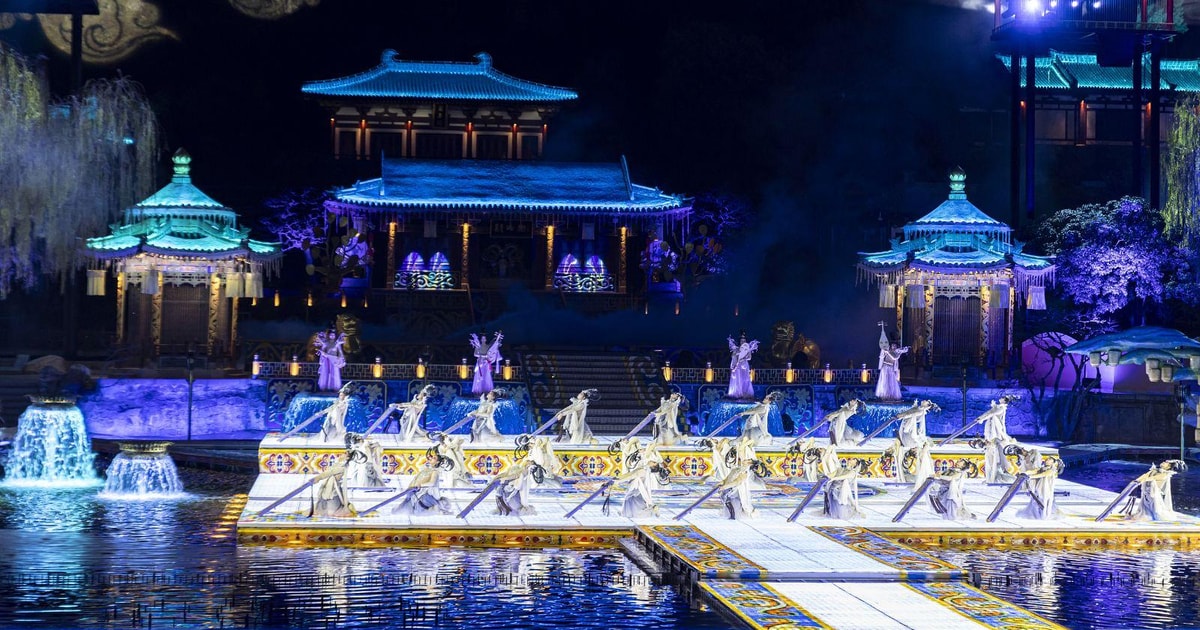
The booking page promises high-tech lighting, sound and effects, and the photograph on this page shows white-robed dancers on a glowing platform before lit pavilions. Outdoors, the night sky and the mountain do some of the set design for free.
The setting
Huaqing Palace sits at the foot of Mount Li in Lintong District. Wikipedia describes a hot-spring site with almost three thousand years of palaces behind it, and the setting the poem Chang Hen Ge commemorates. Seeing the story told where it is set is half the pleasure.
Who will love it
Couples, families with children and anyone who likes a night of big theatre and history in one sitting. It is a seated show of about an hour, so it fits easily around dinner, and one child under 1.3 m per parent can join free without a seat.
A kind note
If you would rather spend the evening tasting your way through Xi'an on foot, the street-food tour listed further down is a lovely alternative, and the two sit happily on different nights of the same trip.
Seven threads behind the show
Seven threads behind the show
Behind the dancers stand a hot-spring palace, an emperor, a consort, a rebellion and a poem. The seven notes below summarise reference articles, and none of them describes what you will see on your own night.
-
The springs
Almost three thousand years of palaces
Wikipedia places Huaqing Pool, also called Huaqing Palace, at the northern foot of Mount Li, about 25 kilometres east of Xi'an. Its natural geothermal springs have a documented history of almost three millennia and served as the site of palaces built by King You of Zhou, Qin Shi Huang and Emperor Wu of Han, who expanded the complex.
-
The emperor
Xuanzong and a golden age
Emperor Xuanzong of Tang reigned from 712 to 756, the longest reign of the dynasty at 44 years. Wikipedia calls his Kaiyuan era, from 713 to 741, usually viewed as one of the golden ages of Chinese history, a time of stability and prosperity with advances in literature, music and painting.
-
The name
From Wenquan to Huaqing
According to Wikipedia, Xuanzong renovated the complex as Wenquan Palace in 723 and renamed it Huaqing Palace in 747. It adds that the site is famous as the setting of his romance with his consort Yang Guifei, which is the story the show retells.
-
The consort
Yang Guifei, one of the Four Beauties
Yang Yuhuan, born in 719, is better known as Yang Guifei, guifei being the highest rank for imperial consorts of her time. Wikipedia says she was made an imperial consort with that rank on 19 September 745, calls her one of the Four Beauties of ancient China, and notes that she was granted use of the Huaqing Pool, once the emperors' exclusive pool.
-
The lychees
A fruit that became a symbol
Wikipedia says lychees were a favourite fruit of Yang Guifei and grew only in southern China, so they were carried to the capital Chang'an by imperial couriers on fast horses, with riders relaying the delivery day and night. The fruit later became a literary and historical symbol of her exceptional favour.
-
The rebellion
An Lushan and the end of the golden age
The An Lushan rebellion lasted from 755 to 763 and began when An Lushan marched out of Fanyang on 16 December 755. Wikipedia calls it an important turning point in medieval Chinese history. Xuanzong fled towards Sichuan, and at Mawei Station in July 756 the imperial guards demanded Yang Guifei's death.
-
The poem
Bai Juyi's Chang Hen Ge
Wikipedia says Chang Hen Ge, the Song of Everlasting Regret, was written by the Tang poet Bai Juyi in 806 and tells the story of the tragic love between Xuanzong and Yang Guifei. It also lists later works that drew on it, from Chen Hong's prose version to operas by Bai Pu and Hong Sheng.
Summarised from Wikipedia on Huaqing Pool, Emperor Xuanzong, Yang Guifei, the An Lushan Rebellion, Chang Hen Ge and Bai Juyi. They give context only and say nothing about the staging.
A timeline from the first springs to the stage on the water
Eight dates from the first springs to the stage on the water
- Zhou to Han
The hot springs at the foot of Mount Li host palaces built by King You of Zhou, Qin Shi Huang and Emperor Wu of Han
The source: Wikipedia's Huaqing Pool article
- 723
Emperor Xuanzong renovates the complex as Wenquan Palace
The source: Wikipedia's Huaqing Pool article
- 745
Yang Yuhuan is made an imperial consort with the rank of Guifei, on 19 September
The source: Wikipedia's Yang Guifei article
- 747
The palace is renamed Huaqing Palace
The source: Wikipedia's Huaqing Pool article
- 755
An Lushan marches out of Fanyang on 16 December and the rebellion begins
The source: Wikipedia's An Lushan Rebellion article
- 756
At Mawei Station on 15 July the imperial guards demand Yang Guifei's death
The source: Wikipedia's Yang Guifei article
- 806
Bai Juyi writes Chang Hen Ge, the Song of Everlasting Regret
The source: Wikipedia's Chang Hen Ge article
- 1936
The Xi'an Incident takes place at Huaqing Pool, where Chiang Kai-shek is seized by two generals
The source: Wikipedia's Huaqing Pool article
The booking page, line by line
The listing, point by point
The lines below were copied from the booking page on 20 November 2026. Where that page says nothing, this guide stays quiet too, and your confirmation message is the final word.
See open nights ↗The starting fare was read when this page was written, and the price you pay depends on your date and viewing zone.
- The show
- A grand outdoor live-action dance drama at Huaqing Palace, No. 38 Huaqing Road, Lintong District, running for about an hour, with Lishan Mountain as the backdrop.
- The story
- It retells the love story of Emperor Xuanzong and Yang Guifei, using high-tech lighting, sound and effects.
- The words
- Chinese and English subtitles are provided.
- Collecting your ticket
- Bring your passport. It is needed to collect the ticket at the scenic-area ticket office.
- Your seat
- You choose a viewing zone when you book, and seats within that zone are allocated at random when you redeem the ticket.
- Children
- One child under 1.3 m per parent enters free, without a seat.
- Huaqing Palace entry
- Entry to the palace grounds is an optional add-on, so the show ticket and a daytime visit can be chosen separately.
- Changing your mind
- Cancellation is free until the day before, and nothing is charged at booking; the terms for your chosen date appear in the calendar. The page lists the evening as wheelchair accessible.
A show under the mountain or a street-food night
A show under the mountain or a street-food night?
More of Xi'an around the show
More Xi'an bookings to pair with it
The show takes one evening. Beside it sit a three-hour street-food walk, a day with the Terracotta Army and the City Wall, and a family dumpling-making session, each with its own guest rating.
- See dates ↗
The Song of Everlasting Sorrow live show
An outdoor dance drama at Huaqing Palace, with Lishan Mountain as the backdrop and Chinese and English subtitles.
- See dates ↗
Gourmet and street food tour
A three-hour evening walk tasting Xi'an's street snacks and long-loved restaurants, with the stories behind each dish.
- See dates ↗
Terracotta Army, City Wall and pagoda day with lunch
One day for three of Xi'an's headline sights, with lunch at a local family's table beside the Terracotta Army, rated by more than six hundred guests.
- See dates ↗
Dumpling making, tea and noodle pulling
Make dumplings from scratch with a local family, then taste tea and try stretching belt noodles by hand.
Also bookable in Xi'an
Sorting out the night
Four things to settle first
Choose your zone
Pick the date and the viewing zone that suit you. Seats within a zone are allocated at random when you redeem, so the zone is your choice and the exact seat is a pleasant surprise.
Pack your passport
The ticket is collected at the scenic-area ticket office, and the booking page says a passport is needed. Keep it in your bag with the booking message.
Plan your own way there
The booking page offers no transfers, so arrange your own route from central Xi'an to Huaqing Palace, which Wikipedia places about 25 kilometres east of the city. Check the forecast too, since the show is outdoors.
Fit in the rest of Xi'an
The show fills one evening. The street-food walk suits another night, the Terracotta Army day takes a full day, and the dumpling session is a relaxed way to spend a morning.
Six deeper reads
Six reads on the palace, the lovers and the poem
- Start here Is The Song of Everlasting Sorrow at Huaqing Palace worth an evening in Xi'an? Reading a 5.0 from its first guests An outdoor dance drama beneath Lishan Mountain, weighed up: what the booking page promises, what the setting adds and who will love the night most. Read →
- The comparison The Song of Everlasting Sorrow or a street-food night: which Xi'an evening? A live dance drama at Huaqing Palace set beside a three-hour evening food walk, compared on format, pace, setting and who each suits. Read →
- The palace Does it help to know Huaqing Palace before the show? The hot springs and the Tang court The springs at the foot of Mount Li, the emperors who built beside them and the 1936 incident that put the palace in the headlines again. Read →
- The lovers Is the Xuanzong and Yang Guifei story easy to follow without Chinese history? The lovers behind the show Who the emperor and the consort were, how their story began and why it still moves audiences more than twelve centuries later. Read →
- The poem Will Bai Juyi's poem make the show richer? The Song of Everlasting Regret explained Who Bai Juyi was, when he wrote the poem and how it carried the lovers' story from a palace hillside into the centre of Chinese literature. Read →
- The ending Does the An Lushan rebellion explain the sorrow in the show? The road to Mawei How a general's revolt ended the Tang golden age, drove an emperor out of his capital and brought the lovers' story to its heartbreak. Read →
FAQ
What guests ask before booking
Is The Song of Everlasting Sorrow in Xi'an worth it?
Yes. It earns the top score from the guests who have seen it, and it brings a famous Tang love story to life in the open air at Huaqing Palace, with Lishan Mountain behind the dancers and Chinese and English subtitles to follow along.
How long does the performance run?
The booking page gives about an hour. The calendar lists the dates on offer.
Is the plot hard to follow?
Not at all. The show retells the romance of Emperor Xuanzong and Yang Guifei and has Chinese and English subtitles. The guides on this site give a short background if you enjoy arriving prepared.
What do I need to collect my ticket?
A passport. The booking page says it is needed to collect the ticket at the scenic-area ticket office.
Can I pick where I sit?
You pick a viewing zone while booking; seats inside the zone are handed out at random when you redeem the ticket.
Can children come along?
One child under 1.3 m per parent enters free, without a seat.
What happens if the weather turns bad?
It is an outdoor show, and the booking page says it can be cancelled for heavy rain, strong wind or other force majeure. If that happens you can reschedule or take a full refund.
Is Huaqing Palace entry included?
Entry to the palace grounds is an optional add-on, so you can choose it when you book if you want a daytime visit as well.
How do I reach the venue?
The booking page includes no transfers, so you make your own way there. Huaqing Palace is at No. 38 Huaqing Road in Lintong District, and Wikipedia places it about 25 kilometres east of Xi'an.